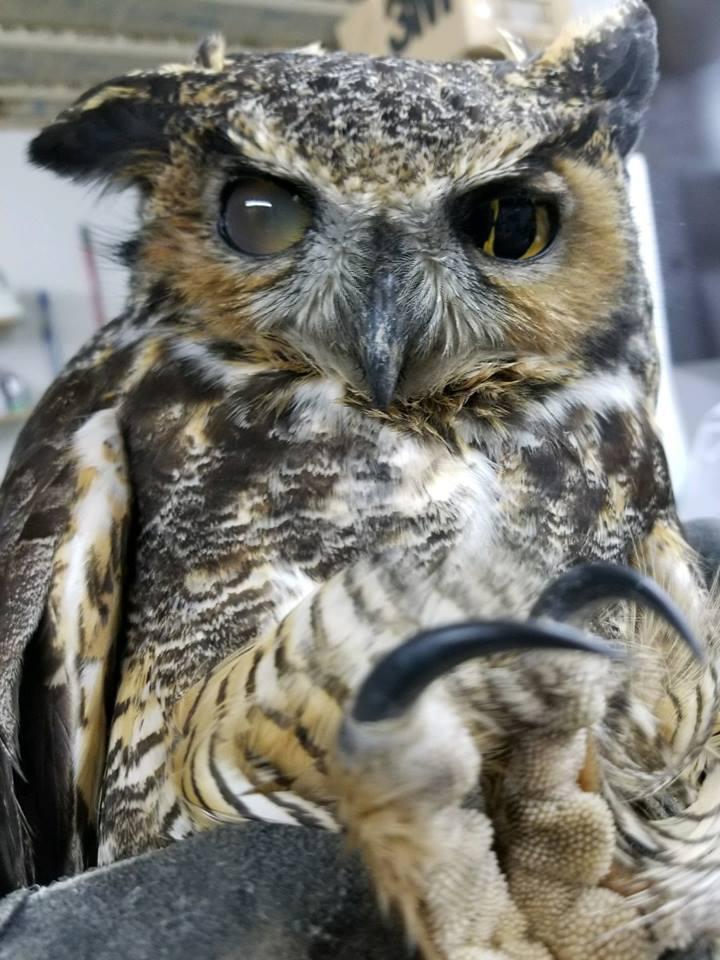
Three people called about a GHO that was seen on the side of the road at Hwy 18 and 5. He was then seen in a field. He was not flying, and had an injury to one eye. A caller on 2/16 had called about the same bird, but when a volunteer went to get it, they could not find it.
On Saturday 2/17/19 Pam received a call from Brandi Sheets in Marion that, on Friday, her son had spotted a Great-horned Owl in a field on SR18. She investigated and noted that the owl had a damaged eye and was having trouble flying. She could find no help on Friday and finally on Saturday she contacted us. Pam asked if I had time to go and get the owl. Fortunately, both the weather and traffic (lack of ISP) were cooperative and I made good time. About 15 miles from Marion, I contacted Brandi and got directions. I met Brandi and her family at an entrance to a farm field. The owl was about 50 feet from the highway in wild grass. After assessing the situation and getting organized, I slowly proceeded down the trail while talking gently to the bird. The owl made several weak attempts to flee but I soon caught up to it where it turned and went into a defensive posture. I placed my trusty minnow net over the owl’s head and grabbed its talons. The bird barely struggled and seemed content to be held against my chest. A quick check showed that the right eye was cloudy, the left eye iris was injured, the keel was very sharp, the wings seemed undamaged, the legs were undamaged. I decided to get the bird to the ICU as quickly as possible. After the Sheets took a few pictures and a I made a quick stop for gas, I was back to Huntertown a little quicker than the south bound trip. Fortunately, I had “Kim Kamando” as shotgun. Barb Hathaway met me at the ICU. With help from Ted Geers, we gave the bird a more thorough examination. We treated the eyes with eye drops and ophthalmic ointment. During our inspection we found some scabs around the right ear, which we treated with antiseptic. We then gave the owl Baytril, an antibiotic, orally. We hydrated the bird with sub-q injections of lactated ringers solution. There were numerous “burrs” in the leg feathers. We also discovered that the owl’s back appeared to be “skinny”, lacking much muscle. During the time we examined the owl, it seemed to go to sleep. However, after putting it in a cage, it stood straight up and glared at us like a nasty, mean owl; a good sign. Doctor Pat and VT Kat will need to administer to the bird next.
Intake #02172018